
The life and adventures of a perpetual traveler. With a few survival and fieldcraft skills thrown in.
Saturday, September 23, 2023

Thursday, January 19, 2023

"Wild Bill" Moreland AKA "The Idaho wildman", survived 13 years, in the wilderness of Idaho, with very little in the way of equipment. When apprehended by the authorities, his gear consisted of, A canvas tarp with rope sewn to the ends, a wool blanket, the clothes on his back, a coffee pot, skillet ,flint & steel, pocketknife, and some hooks & line that he scavenged from rivers and streams.
He was known to used fire-tower phone wires to snare deer. The gear he possessed was stolen from cabins and hunting camps. He found a single shot .22 rifle and a box of ammo in a cabin he raided. over his last 2 years in the wilds, he fired only 24 rounds, taking one deer with each round. He said that he aimed for the head, and was always able to stalk within a few yards of the deer before firing.
I know for a fact that none of the current world survival "Experts" has never lived for any length of time off grid. And when they do they usually have a whole truck load of gear to help them along. I seriously doubt that any of the manufactured "experts" in wilderness survival could survive anywhere except on youtube or TV.the ends, a wool blanket, the clothes on his back, a coffee pot, skillet ,flint & steel, pocketknife, and some hooks & line that he scavenged from rivers and streams.
He was known to used fire-tower phone wires to snare deer. The gear he possessed was stolen from cabins and hunting camps. He found a single shot .22 rifle and a box of ammo in a cabin he raided. over his last 2 years in the wilds, he fired only 24 rounds, taking one deer with each round. He said that he aimed for the head, and was always able to stalk within a few yards of the deer before firing.
I know for a fact that none of the current world survival "Experts" has never lived for any length of time off grid. And when they do they usually have a whole truck load of gear to help them along. I seriously doubt that any of the manufactured "experts" in wilderness survival could survive anywhere except on youtube or TV.
Tuesday, September 27, 2022
Tiksay fishing in the Philippines
.jpg)
.jpg)

.jpg)


Monday, September 26, 2022
Clark Gable – WWII B-17 Aerial Gunner

Clark Gable – WWII B-17 Aerial Gunner
William Clark Gable (1901-1960) was born to a protestant father working as an oil well driller and a catholic mother who died when he was 10 months old. As a young man, he worked at oil fields and as a horse manager until he gradually broke into the world of theater and screen acting. By the time of America’s entry into World War II he was already a highly acclaimed actor and the star of such movies as It Happened One Night (which earned him an Academy Award), Mutiny on the Bounty and, of course, Gone With the Wind.
 In 1939, he married actress Carole Lombard, his third wife. The following years were the happiest in Gable’s life, but the idyll was cut short by tragedy. On January 16, 1942, Lombard was flying home from a war bond promotion tour when her plane crashed, killing everyone on board. Gable was emotionally and physically shattered, losing 20 pounds in a month. He enlisted in the U.S. Army later that year, almost certainly as a way to cope with the personal loss. Before her death, Lombard encouraged him to do so. After a public announcement of his intention, Commanding General of the USAAF Henry “Hap” Arnold offered him a special assignment in aerial gunnery.
 Gable, already 41 years old, considered enrolling in officer candidate school, but eventually enlisted in August 1942 as a gunner on a bomber. His studio, MGM, arranged for Andrew McIntyre, a cinematographer and personal friend, to accompany him during training. Once enlisted, he was sent to officer training anyway. He was commissioned as a 2nd lieutenant and was as the graduation speaker of his class. It was after his commission that General Arnold explained the nature of his special assignment. The USAAF was facing a shortage of aerial gunners and he wanted Gable to shoot a propaganda film to increase enlistment rates.
Gable was promoted to captain and sent to England with the 351st Bomb Group of the 8th USAAF as head of a six-man film crew. He took his duties seriously and shot a wealth of material interviewing air crew members. He was also willing to party when appropriate and became popular with the enlisted men. In order to acquire aerial footage, he also went on combat missions on several B-17 Flying Fortresses (he was attached to the group, but not to any specific crew). Official papers record five missions flown by him as an observer-gunner, though some veterans who served with him claimed he went on more.
Of the five recorded flights, one, an attack on a chemical plant in Norway, was the longest mission flown by the 8th Air Force up to that point. Another, a large raid on Germany’s industrial Ruhr Valley, was the 8th’s most dangerous flight to date, with 25 planes out of 330 shot down by the enemy. During an attack on his plane, Gable was wedged behind the gunner in the cramped top turret, shooting footage of German planes making five passes at the bomber formation. As he was handling his camera, a 20mm shell penetrated the bomber from below. Gable and the gunner dodged death: the shell cut off the heel of Gable’s boot, flew past him and exited the plane a foot from his head, all without exploding. When later pressed by reporters, Gable said he didn’t even notice the shell at the time and only saw the exit hole later.
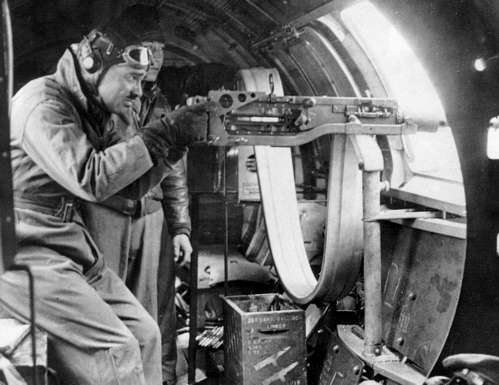 Gable probably didn’t know that his actions over Europe earned him the attention of an unlikely fan: Adolf Hitler himself. He was Hitler’s favorite actor, probably in part due to his Rhinelander and Bavarian ancestry and the Führer offered a significant bounty to whoever captured the actor unscathed.
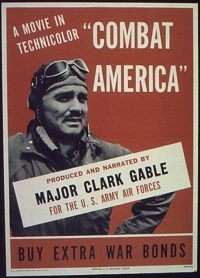 In November, Gable returned to America with 50,000 feet of film, ready to go into the editing room, only to find that the gunner shortage had already been rectified. Nevertheless, he was allowed to finish the 62-minute film and Combat America premiered in movie theaters in 1945.
In 1944 Gable was promoted to major. He wanted to fly more combat missions but was not assigned to any combat units during the invasion of Normandy. Realizing he wasn’t going to be allowed on missions any more due to his age, he requested his relief from active duty, which was granted. By coincidence, his discharge papers were signed by a later U.S. President: then-Captain Ronald Reagan. Shortly after his retirement from military service, he put his personal experience to good use in Command Decision, a 1948 film about the politics of and the emotional toll on commanders, in which he played a fictional brigadier general supervising raids on Germany.
Take a look at these other WWII Posts:
- Combat America: by Clark Gable
- Rosie the Riveter Photographs
- B-17 Survival Story
- Clark Gable Reproduction Dog Tags
Thursday, September 22, 2022
When Ted Moore and Glenn Woods Shot Down A Biplane From A Huey Helicopter in Laos

The year was 1968. And Operation Thunder – the aerial bombing of military targets in North Vietnam – was in full swing. These bombing raids were having a crippling effect on the North Vietnamese war effort, and the North Vietnamese Army commanders decided it was time to do something about it.
The target of the North Vietnamese strike was Lima Site 85 on the border between Laos and North Vietnam. This site was situated on top of a 5,800-foot karst mountain jutting out of the jungle. Because of its sheer cliffsides the site was accessible only by aircraft, or by foot up a steep single-file, winding trail on the mountainside.
Captain Ted Moore and crewchief Glen Woods were inbound to site 85 in their unarmed Air America Huey helicopter to bring ammunition supplies to the site. They could hardly believe their eyes when they saw the biplane attacking Site 85. Moore stating that it “looked like something out of World War One.”
Realizing that his chopper was faster than the AN-2s, Moore decided to give chase, and Woods got his AK-47 ready for combat. It didn’t take too long for the Huey to catch up to the slow, unwieldy biplanes, and soon it was in striking distance of the rearmost AN-2.
Because the rearward visibility of the AN-2 is severely limited, the pilot of the biplane didn’t realize the Huey was upon him until it was far too late. The downwash from the chopper caused the upper wing of the biplane to stall out, and it began to drop. In desperation, the pilot tried to lower his speed – but there was no getting out of this, because the Americans weren’t quite done with the attack.
As Moore pulled in closer to the floundering biplane, Woods leaned out of the helicopter and emptied his AK-47 into the cockpit, wounding or killing both the pilot and the copilot. That was that;
One of the planes caught fire and crashed into the jungle below. The other flew beneath the helicopter and slammed into a mountainside, Moore said. Americans salvaged electronics from one of the crashed planes. "They reverse-engineered the stuff, and that allowed American planes to know when the MIGs were headed in for an attack," Moore said. "That saved a lot of American air crews. I think that's the best thing that happened."
The Huey veered back toward Laos, and the other biplanes escaped into North Vietnam. This strange aerial victory would prove to be unique in the history of aerial combat – it was the first and only time a helicopter had taken out a biplane. It was also the first recorded air-to-air victory for Air America.
Ted Moore also helped rescue thousands of civilians in Laos in March 1968, picked up downed American pilots and delivered and picked up CIA teams that were infiltrating positions along the Laos-Vietnam border.

The Army MC-6 parachute
Pilatus Porter - my brothers favorite plane
.jpg)

.png)
Wednesday, September 21, 2022
Smokejumpers CIA Clandestine Weapon in Americas Secret Wars

Eugene H. Hasenfus - Nicaragua

https://www.pbs.org/video/wpt-documentaries-eugene-hasenfus-story/
Eugene H. Hasenfus (born January 22, 1941) is a former United States Marine who helped fly weapons shipments on behalf of the U.S. government to the right wing rebel Contras in Nicaragua. The sole survivor after his plane was shot down by the Nicaraguan government in 1986, he was sentenced to 30 years in prison for terrorism and other charges, but pardoned and released the same year. The statements of admission he made to the Sandinista government resulted in a controversy in the U.S. government, after the Reagan administration denied any connection to him.
I remember back in 1986 when I was serving as a military contractor, hearing about Hasenfus. I didnt know the guyand neither do i remember his name or seeing him around the base in El Salvador, but all these years later I find it interesting that we were basically serving in the same "Unit" and doing the same job. I guess that can be said of most if not all of the contracts I have done since late 1979.
If you read about Eugene and look at the pictures, it is cool to note that he is dressed in a "Grey man Uniform" i.e., civilian clothing and not the mufti that is common with contractors now a days. It also interesting that when captured he was sleeping in a hammock he made from his parachute, obviously a skill he learned at JOTC in Panama or JEST in the Philippines. Either way his application of acquired skills are what saved his life - Grey man attire, survival skills and parachuting.
Tomahawk, Out!
